Sunday, December 21, 2014

The priests, 4

The wise rector’s attitude towards his videoke-loving priests for me reflects our Heavenly Father’s magnanimity of heart, and His Son’s mercy and compassion showered upon shepherds following His footsteps. 
We may adopt Pope Francis’ most frequently quoted (and misunderstood) question, “Who am I to judge?” in reflecting upon what we perceive as erratic ways of our priests.  To begin with we can ask the Lord to show us how our own weaknesses are feeding those of the priests.
Priests do not live in a vacuum—we are part of their world, we share in their culpability.  When on account of their soiled hands we hold priests in contempt we may be committing a sin just as grave as that we are condemning.  Do we not pray every day, “Forgive us our sins as we forgive those who sin against us”?  If we can be blind to our own faults, how can we claim to see those of others?  How do we know that these “difficult” priests we complain about do not beat their breasts every night in remorse?  Who are we to weigh their souls and read their hearts?  Who are we to judge? 
We can only beg the Lord to increase our compassion and faith in His mercy for us sinners.  In God’s goodness He tenderly receives us penitents in His Heart, shows us our wounds, and humbles us in secret.  If the Lord can strengthen us to embrace His cross, how much more His anointed men upon whose shoulders He has placed heavier crosses?  We can only marvel at the mysterious ways God melts the hardest of hearts, including those of priests.
A priest in his late 30s—bright, good-looking, energetic, esteemed by colleagues and superiors alike—fell from his proverbial ivory tower when he underwent a so-called executive check up.
Day One at the hospital he enjoyed the attention of the nurses and the doctors who complimented him on his attractive qualities and sizzling energy.  Day Two proved to be a different story.  He was subjected to several tests, samples of his body liquids were taken,  and his insides were prepared for more tests.  He was to say on hindsight:  “That was my first time to be so physically exposed.  That part of my body which for years I had reverently kept for God’s eyes only, became a mere laboratory specimen. While the doctors and the nurses called me ‘Father’, I felt more like a piece of meat being scrutinized, evaluated, and labeled.”
The enema was particularly agonizing, he recalled, “Nothing prepared me for that kind of assault on my dignity. I felt violated.  That was so cruel, far worse than any penance I had experienced in my whole life.  I was wilted when it was over.”
The procedure wearied him physically, but the experience soon enveloped his being in a newfound self-knowledge: “I realized I had presumptuously placed myself above others (less gifted); I was riding high, on top of the world, with my future assured, deserving of everything good thing I was receiving—until that ‘executive check up’ pulled me back down to earth.  I had to accept that like everybody else, I am made of corruptible stuff.”
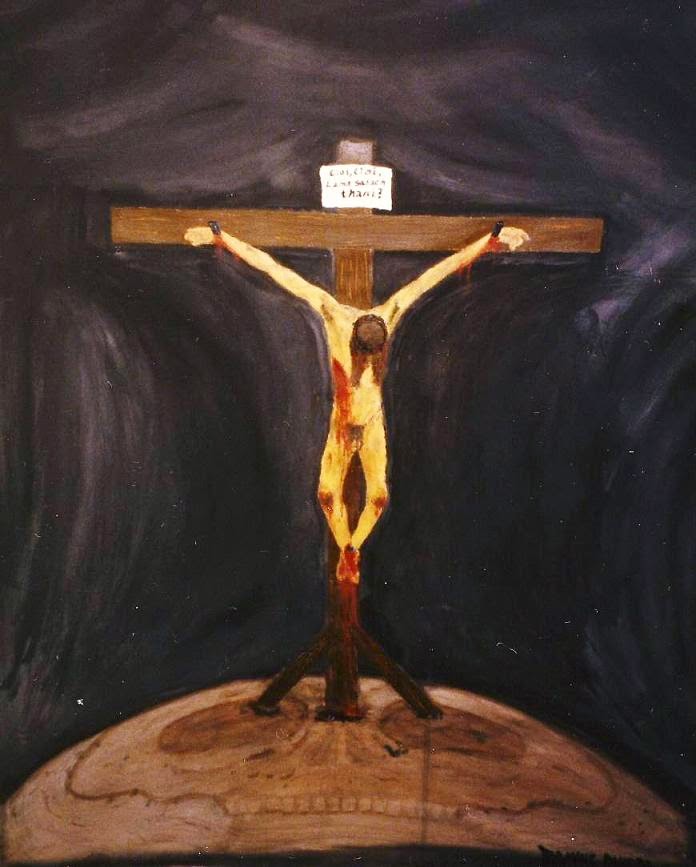
About two weeks later, still struggling to erase the enema episode from his memory, this young priest was to see with fresh eyes something he had always taken for granted.  “Jesus took me by surprise,” he said, “it was during Mass, I was seated, waiting for the singing to end, when I glanced at the small crucifix on the altar.  The realization struck me like lightning:  the ‘Father’ attached to my name is a mockery if I am not willing to be naked like our Lord on the cross.”
Like bolts of lightning, too, the images flashed back to his memory of his nakedness in the hands of the medical personnel:  “I was virtually transported back to my  private air-conditioned hospital room with cable television, refrigerator and telephone, the fresh bed linens, gourmet meals, flowers from friends and admirers, my favorite cakes and ice cream filling up the refrigerator, a coterie of nurses at my command—and I was not even sick!  This man, this man on the cross had NOTHING!”
(To be concluded)
I believe the priest's sentiments are echoed in this moving painting of our Lord Jesus, naked on the cross.  Instead of writing a mere caption, i urge you read the story behind the painting here, http://art-for-jesus.blogspot.com/2008/04/crucifixus-naked-son-of-man.html

Saturday, December 06, 2014

FAQs about Pope Francis’ visit to the Philippines


(Here’s an everything-you-wanted-to-know-but-didn’t-know-whom-to-ask article that answers questions sent to the papalvisit.ph website)
Q.  What is the route of the pope going to Luneta?  We want to make sure we get a better glimpse of him by positioning ourselves where the motorcade will pass.
A.  The authorities are still mapping out the routes for all the events during the papal visit, and will most likely disclose the details very close to or during the visit itself.  But if you noticed the past papal visits, the pope’s motorcade never passes through side streets—only through main roads.  Your planning might be helped by knowing the itinerary of the Pope, which was announced at a press conference last November 14.  You may find and copy it from the official website, www.papalvisit.ph.
Q.  The news said that in Korea, Pope Francis rode an ordinary Kia car.  Will the Pope ride a bulletproof popemobile in the Philippines? 
A.  This is a most repeated question especially by reporters during press briefings.   And the answer is always “Nobody knows”.  It may be top secret but one thing sure, Pope Francis wants nothing ostentatious or pricey.  He likes touching people, and since this pope— besides being so “makamasa”—has been known to be a “pope of surprises” we won’t be surprised if he turns up in an open and very Pinoy dyipni.
Q.  After Mass the other day, the priest said we should hurry to secure tickets to places where the pope will appear but didn’t say how.  Where we may apply for these tickets?
A.  No tickets are issued, given away, or sold by the Papal Visit organizers.  Beware of anyone who tries to sell you passes, accreditation cards, or tickets to any papal visit event.  All events may be witnessed by the public, although the meetings with the particular interest groups (youth, inter-religious, families) will be participated in by pre-selected representatives. 
Q.  Is the Mass with bishops, priests and consecrated persons at the Manila Cathedral open to the public?  We hear that only invited persons may attend it.  We are religious sisters, but we are not invited.  How may we participate there and in the Luneta?  
A.  You are right, since the cathedral can accommodate only so many, dioceses from all over the country will just be sending delegations to the event.  However, as with other major liturgical celebrations held at the Manila Cathedral, whatever goes on inside will be projected on huge screens outside.  There will be tents with seats in front of the cathedral; be there early to find a comfortable niche before the crowd sets in.  It will be the same situation at the Eucharistic celebration in Luneta.  Try asking for assistance from your parish priest or bishop who might be planning to attend these public gatherings.
Q.  Is the Dialogue with the Youth at the UST open to the public?   We are a youth group from Bacolod City, may we be given slots for this event?
A.  The event is open to the public, but the quadrangle will be cordoned off and reserved for students who will be issued proper passes.  You may obtain accurate information from the Chancery or the bishop’s office in Bacolod—they may be organizing youth groups to send to Manila.  For more details on the encounter with the youth at the UST, please inquire by calling the UST Office of Public Affairs, tel. (02) 731-3544.
Q.  When Pope Paul VI visited the Philippines, he went to UST.  When Pope John Paul II came, he also visited the UST.  Now Pope Francis is coming, he will also visit the UST.  Why always UST?  How lucky can UST get?
A.  This is a very good question from a rather perplexed inquirer.  Here’s a brief explanation: the University of Santo Tomas is a pontifical university, directly under the authority of the Roman Pontiff—the successor of Peter, the first pope. Aside from its function as a regular university, a pontifical university has a special mission of spreading the Gospel and promoting the teachings of the Catholic Church.  The Rector of a pontifical university is appointed by the Vatican, and whenever the pope travels to a country where there is a pontifical university, it is his duty and pleasure to visit this university not only to see how it’s doing but also to inspire and encourage its students, faculty, and staff in their evangelization efforts.
Q. We are from Mindanao and we are very interested in joining our Holiness Pope Francis at the meeting with the families at Mall of Asia. Is there any reservation to be made? May I know any contact person and number or how much do we pay for this special event?
A.  The Meeting with Families will be attended by families pre-selected by the Dioceses.  Your best source of information would be your own parish and the diocesan office, wherever in the Philippines you happen to be.   Your parish priest would be a proper conduit to the bishop, and should be able to provide specific answers to your questions.
Q.  According to the papalvisit.ph website, only professional journalists and photographers may be accredited to cover the event.  I am editor-in-chief of our university’s paper, we are planning to cover the event; may we be allowed to apply?
A.  You read the website right—only professional journalists will be accredited to cover the event.  Yu may apply for accreditation but to be approved, applications undergo a tedious sifting process Enthusiastic staffers of school organs and university publications may, of course, mingle with the public and produce great human interest stories which may be published in the official website blog, or in their own blog, linked to papavisit.ph Facebook.
Q.  I’m from Malaysia, and would like to go to the Philippines during the pope’s visit.  Are there any tour groups traveling from Malaysia to Philippines in January? 
A.  None that we’ve heard of, although we have been told of Overseas Filipino Workers intending to come home for the pope’s visit.  Why not ask around the travel agencies in your own place of origin, whatever country you’re coming from.  They would have up-to-date information, and if you wish to inquire about local tours in the Philippines, you may also request your agency to inquire and book for you.
Q.  A friend (Filipino) in Switzerland told me somebody has been raising funds for the papal visit, presenting a letter signed by Cardinal Tagle and another person, instructing them to deposit their donations to her account in the Philippines.  A number of trusting and generous persons have donated, but my friend would rather follow the proper procedure.  Do you have an official bank account for receiving papal visit donations?
A.  It’s good that your friend is asking first before parting with hard earned money.  We are not sure about that fund-raiser in Switzerland, but should you or anyone you know wish to donate, the Papal Visit Finance Committee chair Msgr. Clem Ignacio advises that you make all check donations payable to RCAM-PAPAL VISIT.  You may also deposit to Bank of Philippine Islands, BPI Current Account # 0051-0556-75, or to Security Bank, SB Savings Account # 0061-015085-001.  All donations are receipted, so when you deposit, kindly inform the Finance Committee by calling tel. (02) 527-6995, or emailing a copy of your deposit slip to finance.papalvisit@yahoo.com, so that your contribution may be properly identified and receipted.  For further inquiries, please fax or call the office of Msgr. Clem (02) 527-2995, and talk to Maria, Kish or Mildred.
Q.  Where will Pope Francis stay during his visit?  Will it be    the Manila Hotel?  Besides being a historic hotel, it is in Luneta, faster and safer for the pope to get to the grandstand.
A. This is one of those things the papal visit organizing committee is mum about, for understandable security reasons.  Yours is a thoughtful and practical suggestion, but we have no answer to your question. We can only echo the assurance Cardinal Tagle gave to the curious reporters at a press conference who posed the same question:  “Tiyak, may matutulugan siya!”  (For sure, he will have a place to sleep).
Q.  I saw the itinerary on Facebook.  I’m wondering why Malacanang is first on the list.  Is it more important than the Mass with bishops at the Manila Cathedral?  Pope Francis could also use more time to be with the poor.
A.  The pope’s trip to the Philippines is both a state visit and a pastoral visit.  Being the Head of State of the Vatican City State, the pope is also welcomed by the Head of State of the host country.  He will be given arrival honors, have bilateral talks with  President Aquino and address government officials and the diplomatic corps in Malacanang.  We should rejoice that Jesus in the person of Pope Francis will be welcomed and heard in the presidential palace.   
Q.  Where may I buy Pope Francis’ book “Education for Choosing Life: Proposal for a Difficult Time” locally and what is the cost?  I would like to give it to my son and my daughter-in-law, both high school teachers.
A.  That’s a good gift idea, because this book contains messages to teachers given by Jose Cardinal Bergoglio when he was Bishop of Buenos Aires.  Unfortunately, that book may only be sold in the United States and Canada, according to the Ignatius Press website.
Q.  I and two others are customizing calendars for different parishes for commercial purposes.  May I know if we may use the official logo of the papal visit?  A related question: I have a very small store and also print personalized t-shirts as a hobby. Can I print our beloved pope's official logo on t-shirts and sell them to those who want so we can also wear papal shirts to show support for his visit to our country?
A.  The official logo is copyrighted and may not be used for commercial purposes.  So as not to dampen your enthusiasm, we respectfully suggest you create your own logos and designs bearing the essential elements of the visit, like the theme “Mercy and Compassion” coupled with an image of Pope Francis.  It will be a challenge to your inventiveness but your product will also be unique yours, something that might give you a greater sense of accomplishment.
Q.  How may we get a spot/booths where we may sell memorabilia at Luneta?
A.  You may have to ask the Manila city government about this, if a special permit is required, or if you can just randomly pick a spot and sell your items.  You may also inquire from the office of Bishop Pablo S. David, Holy Rosary Parish, Sto. Rosario St., Angeles City (Pampanga), tel. (45) 888-6355.  Bishop David is Chair of the Papal Visit Physical Arrangements Committee.
Q.  Where may we submit a quotation for portable toilets?
A.  Try inquiring from the office of Msgr. Clem Ignacio who heads the Papal Visit Finance Committee, tel. 527-2995.  You may also need permits from the Manila city health department since portable toilets affect sanitation.
Q.  Will the pope have a dialogue with HIV/AIDS patients?  I hear that dioceses give access to PWD (Persons With Disabilities) but since I am not a PWD, I don’t ask to be included.
A.  To date the visit’s program seems set, and there is no mention of a dialogue with HIV/AIDS patients.  For your information, it is the Vatican who decides on the itinerary and all the pope’s activities during the visit.  Every week since last November 24, the Media Committee conducts press briefings at its general headquarters in the Knights of Columbus compound in Intramuros (across the NCCA offices).  Always present at these briefings is the head of the Media Committee, Bishop Mylo Vergara, with different panelists from the Church and the government each time, depending on the topic to be discussed.  The media then disseminate the latest updates; you may watch for them in the news, or visit www.papalvisit.ph for more information.

(To be continued as more inquiries pour in.  Prepared by Teresa R. Tunay, www.papalvisit.ph editorial department)


Wednesday, November 26, 2014

The priests, 3

What thoughts ran through my mind as I sat through the virtual videoke night cum bikini festival with the priests?  I’m certainly no prude—being an erstwhile fashion editor, I can accept fashion as self-expression, but I also acknowledge certain limitations to that kind of exercise. 
My mother, queen of tolerance herself, surprised me one day I was to have a beach outing with my staff—a jeepney load of male and female 20-somethings.  With us was a priest, our moderator.  She said, almost shyly, “Pag maliligo kayo kasama ng pari, magsosoot kayo ng shorts.”  Shorts, over our swimsuits?  “Yes.”  But what for?  “Huwag ninyong ipapakita mga singit ninyo sa mga pari; hindi maganda iyon,” she continued.  I didn’t get her drift, but I did honor my mother’s concern by telling the girls about her reminder. 
On the way home from the same outing, during a “CR” stop at a gasoline station, I caught two of the boys snickering as they came out of the toilet.  “What’s so funny,” I asked.  “Si Father, naglagay ng tuwalya sa kandungan niya, me tinatakpan! (Father put a towel across his lap, covering something).”  I shrugged, “He’s just being modest, he’s in shorts.”  They laughed aloud and snickered some more, exchanging knowing glances.  For my quizzical look, they returned a comment that went over my head:  “Siyempre, lalaki kami eh! (Of course, we are male!)”  I dismissed the incident, but back in the jeepney, I did notice a towel across Father’s lap; it reminded me of jeepney-riding girls in mini-skirts who tug at their hemlines and cover their laps with their handbags.
Back in Manila with the staff, preparing to go our separate ways, Father discreetly whispered to me:  “Turuan mo ngang maupo yang mga anak mo.  (Teach your children to sit properly)” referring to the girls with us.  I was perplexed by his sudden concern but I didn’t need him to say anything more.  I got it: two plus two equals four.  In the jeepney, Father was sitting across from the girls, and the one directly opposite him was in shorts.  Ah so… it dawned on me: that’s why the giggly boys were saying “Siyempre, lalaki kami eh!
Men are men—that was the unspoken dictum behind my mother’s reminder about wearing shorts over our swimsuits.  That was the memory that smoldered on in the back of my head as I beheld the bikini parade while trying to enjoy the priests’ singing.
 What impressed me about Fr. Rector’s reply to my query then (about the videoke session’s regularity) was the tone of paternal indulgence in his voice.  He sounded as though he were a father with a dozen sons to feed, clothe, shelter, and love, no matter what.  Even if his sons were to resemble in misdemeanor the Dirty Dozen—drawing on the walls, messing up the bathroom, spilling milk on the carpet, throwing pies at one another’s face, knocking down furniture while playing war games, never giving him a quiet moment—still they were his sons, and he will give them anything they want, anything, just to keep them all gathered in his house. 
(To be continued)

Wednesday, November 12, 2014

The priests, 2

-->
In his reflection on the priesthood at Casa Marta last January, Pope Francis cautioned priests against becoming “smarmy.”  Now that sounds like something British teenagers say all the time, but given his style and personality, the pope couldn’t have chosen a more precise word, because “smarmy” means “ingratiating and wheedling in a way that is perceived as insincere or excessive.”  Tell me if “smarmy” applies to the following priests (whose identities we will hide under fictitious names):
His most available parishioners claim that “Fr. Trek is okay except for one weakness—he is under the saya of a rich matron in our parish.”  They note that he is normally easy to get along with until conflicts arise, in the parish council, for example.  Viewpoints and personalities clash but fair or unfair, rain or shine, the rich matron prevails.  Her ideas may not be the best, they may even be “corny” or “baduy” but she gets her way because Fr. Trek supports her, even against his better judgment.
They are sure there’s nothing romantic between the two “because she’s old enough to be his grandmother”; rather, they add: “We understand that Ma’am Matrona donates a lot—a lot—to the parish projects, we appreciate that, but we also wish she wouldn’t ‘donate’ so much to Fr. Trek.  Every time she comes back from abroad there’s always a pasalubong for him from Ferragamo, Bally, Florsheim.”  It’s hard to just laugh it off, they say,  because the obvious bond between the two—“yung pagkakampihan ng maglolang iyan”—affects their efficiency and tends to turn off competent parishioners whose talents could really improve things in the parish.
In another parish, Fr. Pol is known for his often sour disposition.  “Hindi naman siya masama, sumpungin lang, (He’s not really bad, he’s just moody)”, parish leaders say, “pag may sumpong, hindi mo malapitan, kahit kailangang-kailangan mo na ang pirma niya, matatakot ka kasi parang bulldog sa bangis (When he’s in a bad mood, he’s unapproachable, even though you need his signature badly you keep distance because he’s as ferocious as a bulldog).”
Fr. Pol’s parishioners have learned to tolerate certain delays in parish procedures due to his moods, which they see as some kind of chronic illness, but “Nagtataka lang kami, bakit pag ang kausap niya ay si Mayor o si Gob, nagagamot ang sumpong niya? (We just can’t help wondering why he seems cured of his moods when he’s dealing with the mayor or the governor).”
Pope Francis further said last January, “And how damaging to the Church are smarmy priests!  Those who put their strength in artificial things, in vanity, in an attitude... in a cutesy language... But how often do we hear it said with sorrow: ‘This is a butterfly-priest,’ because they are always vain... [This kind of priest, even though anointed] does not have a relationship with Jesus Christ! He has lost the unction: he is smarmy.”
Instead of “smarmy”, however, “squirmy” is what the following incident made me feel.  One day I was invited to dinner at an institution where many priests reside.  After dinner—which was sumptuous by any standard—we all went to something like a recreation room, with tables and chairs and a huge tv set.  “Oh, I gleefully thought to myself, we’re going to watch a movie!”  But before I could ask what movie that was, the priest setting up the system started to test the mike.  Ah so… it’s sing-along time, it’s a videoke room!

Some priests came in with plates of hot dogs and drinks both soft and hard.  And faster than lightning the songs began—My Way, Leaving on a Jet Plane, Besame Mucho—while the images flashed on the screen—girls in bikinis.  Blondes, red heads, brunettes, they strutted about, draped themselves on velvet couches, bared their nubile bodies on the beach, and popped their over-endowed breasts before the camera.  These bikini bombshells were the standard background visuals for all the songs.  All the songs!  Even when a priest was belting out a Beatles favorite—“When I find myself in times of trouble Mother Maaaary comes to me, speaking wooords of wisdom let it beeeee….”  I observed the angles of the shots, the focus—and concluded with certainty that the cameramen who took these videos never suspected there would be men with a vow of chastity among their audience. 
I had thought long ago that due to my vast experience, nothing could shock me anymore.  That night I was proven wrong.  Nothing prepared me for that.  Stunned but nonetheless concerned, I politely asked my host, the superior of the house, “Does this always happen?  You know… these videoke pictures…With drinks and pulutan pa, when we had just had a very rich dinner?”  Fr. Superior said matter-of-factly but with a tinge of resignation in his voice, “Yeah, yan ang gusto nila eh! (Yeah, that’s what they want).  Really?  “Gosh,” I told him, “I hope you choose people you invite to this!  Not everybody will understand you.”  He assured me he had believed I would understand.
I did understand but I couldn’t help being squirmy about it.  Being in a roomful of priests singing with their eyes on a screen animated by those barely clad Caucasian bodies, I was suddenly reminded I was female.  I had never before felt so uneasy being female, because my gender never got in the way of my work.  In the late 70s, many years before my hair turned gray, I crossed the Atlantic on board an oil tanker with 43 seamen, interviewing them and gathering data for two weeks, from New York to Rotterdam and back—not one moment did I feel ill at ease about being the only woman on board.  But now, trapped by civility with a dozen anointed men in a virtual videoke bar, I, a hardboiled journalist, was absolutely stupefied.  My only consolation was, it was a joy listening to the singing priests.  In fairness, I must say ALL of them have wonderful, recording-quality voices.
(To be continued)

Wednesday, October 29, 2014

The priests

-->Why is it that almost always, during communion, people tend to prefer receiving the Body of Christ from the priest instead of the special ministers of the Holy Eucharist?  Even when the queues for the latter are getting shorter, few of those lined up for the priest would bother to switch lines.  With bishops it’s even worse—nagsisingitan pa.  A survey on this phenomenon—paging SWS and Pulse Asia!—would certainly yield interesting results because (according to my private mini-survey) people “feel it more” when the Host comes from the hands of a priest.  Somehow they perceive the priest as “closer to God” while the special ministers of the Holy Eucharist are just…well, special. 
The thing is, people look up to priests.  They like to think that these men in cassocks are their links to God, and therefore, holy.  They believe priests have “clean hands”.  Thus, when they find out that priests can have soiled hands or feet of clay, or somehow fail to live up to their expectations, they get disappointed. Not seeing Christ in the person of the priest, they walk away—their fervor cools off, they stop coming to church, they convert to other religions.  (I know, I know, it all sounds so unfair and unjust, for priests are human beings, too, but wait—I’m just mirroring the truth for everyone.  Walang personalan, trabaho lang).
This lady I know—a most congenial person, being in the PR business—tearfully admitted to me that she used to be a devout Catholic.  Raised a colegiala she fulfilled her religious obligations as expected of her—until she fell in love with a married man.  Head over heels in love she said she was “in bliss” with the guy but her conscience bothered her.  For a long time she inhibited herself from communion because she was aware she was in a state of grievous sin.  The day came when she felt she had missed communion for too long, and so she desired to receive Him. Soon.
Resolute and unswerving, she decided to “return to Jesus”.  She hadn’t broken off with Mr. Married Man but she intended to, soon.  She went to confession, seeking forgiveness and hoping to be strengthened by the priest.  Instead, she got bawled out of the confessional box.  “I had barely begun my confession,” she said, weeping bitter tears, “why did he shout at me?  He said ‘That’s a mortal sin, get out of here, get out!’ and slammed the window shut.  It was so loud everybody heard, I was sooo embarrassed!”  Sobbing, she left the confessional in shame as “everyone stared at me as if I’m naked”, and she never went back.  Soon she joined a “born again” community.  “I went ready to give up the man.  I needed guidance and to be led to God’s forgiveness, but instead I found condemnation.  At that moment I felt God didn’t love me at all.”
“Linda”, an active parish worker, middle-aged female, witnessed something that disillusioned her about their “beloved parish priest”.  Linda had been a cheerful volunteer, helping out in so many ways in the parish activities despite the lower class status.  For the priest’s birthday that year, she had trained a group of women from the parish’s depressed areas to do a musical number with which to serenade the priest.
At the appointed time their group got to the church, excited in their costumes, complete with guitars and tambourines.  Since she had access to the convent she went in while the group sat in the church, waiting to perform for the birthday boy.  The priest, apparently irritated, told her, “I can’t stay, I’ll be late for a meeting with the bishop. Tell them I’m already out.”  With a heavy heart, she did as told; the group left crestfallen. Linda said, “All those hours practicing went to nothing.  These were poor women, it was the only gift they could give to Father, but he had no time for it.”  But it wasn’t the end.  Linda discovered that very afternoon that “Father didn’t have a meeting with the bishop, he played tennis with his rich friends.  And to think he even made me tell a lie!” 
Now don’t get angry yet.  We’ve only just begun.  There are more stories to tell.  Wait.  As Pope Francis likes to say, our God is a God of surprises.  Who knows what awaits you in the end?
(To be continued)

Wednesday, October 15, 2014

'Same-sex synod' what?

They are at it again—those who have an axe to grind against the Catholic Church are finding media morsels to feast upon at the ongoing Synod of Bishops in the Vatican.  Further exploiting Pope Francis’ most misconstrued quote “Who am I to judge?”,  these people with special interests label what is actually a synod on the family as “same-sex synod”, a “novelty”, an occasion for “hundreds of celibate men” to display once more their “obsession with sex” colliding head on with their “puritanical idealism”.  It is high season for optimistic militant LGBT entities to repackage and resell their pet theories while judging the bishops and the Church as being “outdated” and woefully out of touch with reality.
I follow with mixed amusement and compassion the ways anti-Church advocates—claiming “human rights”—manipulate mainstream and social media to advance their agenda.  They start with looking oppressed—as though gays were the most tyrannized people on Planet Earth.  But are they, seriously?  At least in the Philippines, they are far from oppressed—they are not only accepted, they are loved, adored, and some are even envied for their wealth and popularity.  And their gifts and talents are not just acknowledged by the Church but are welcomed and utilized in its ministry.  I have heard of gay boys being rejected by their fathers, but only in the movies.  All the gay persons I know have no problem with acceptance.
The earliest memories I have of gays are those about the two men in charge of our town’s Flores de Mayo.  “Dalawang bakla lang ang gumagawa ng lahat diyan,” my mother would admiringly inform us, referring to the two middle-aged unmarried men—with soft wrists and hard core devotion to the Virgin Mary—who would virtually bloom whenever santacruzan time came around.  They recruited  sagalas, assigned Reinas their consortes, supervised the makeup, the flower arrangements, the carroza decoration—everything!  It never occurred to me that they were different—maybe I was too naïve to notice, just as I was too innocent to appreciate the biggest role in the santacruzan given to me—Ang Babaeng Samaritana.
No, I think the LGBT champions want more than mere acceptance—they want “gay rights” to be recognized as human rights.  They want marriage (just like the straights), they want their own “family” of adopted kids, and in the process they try to “revolutionize” Church teaching in the name of human rights.  What’s sad is they don’t seem to understand that by fighting for “gay rights” they are seeking affirmation based on mere sexuality.  In a sense they are actually asking people to measure their worth by the yardstick of sexual preference, thereby wasting their own potential as human beings. 
Claiming that the only natural love they know (and the act that accompanies it) is one for and with another person of the same gender, they argue that they have a right to find happiness in love.  “Kasalanan ko bang ipinanganak akong isang sirena?” (Is it my fault that I was born a mermaid?), a lot of gay men I know have jokingly asked.  Like any other person they look for someone to love and to be loved by, and when they do, they have sex without babies (to put it bluntly).  It’s sex to please oneself and the beloved.  Pleasure blinds the indulgent, and this is where their problem worsens.  They drop out of Church, or in any case stop listening to “God talk”—instead they choose listen to “the other side”, and from there it’s a slippery slope to perdition.
Somebody has to remind them of their “divine rights”, to convince them that they are—like everybody else, inside or outside the Catholic Church—children of a kind and loving God.  As such we have a right to ask for strength from our Father in times of temptation.  As His children we all are bound by love to listen to God’s voice, to seek His will in everything we do—and certainly, wasting sexual energy is not one of them. 
“Who says you have to have sex with your boyfriend to express your love?”  I tell this to my gay friends who seem to flit from one fling to another in search of happiness in love.  (They keep getting brokenhearted anyway).  “Happiness in love is not found in human love alone—perhaps, in ‘making you a sirena’ God wants to be your siyukoy (merman)!  But if you keep complaining and marching in the streets for your gay rights, how can you hear the Father telling you He loves you?” 
It is said that hope springs eternal in the human breast.  And so my gay friends still hope that with such a dynamic pope as Francis at the helm, the ongoing synod of bishops will maybe allow same-sex marriage.  “You see,” I tell them, “you’re just listening to the noise!  The Church will continue to love you dearly but it will never bless your same-sex union and call it marriage.”  And that’s the truth.

Wednesday, October 01, 2014

War and the Silence of the Cross

In a recent homily in Edipuglia, Italy, honoring all victims of war, Pope Francis said “War is madness.”  I agree.  War is big business, too—that’s probably why there seems to be no way to stop it.  And irony of ironies, the world’s loudest champion of peace is also the biggest trader in arms.  You’ve guessed it right—the US of A.
Why an “irony”?  Hear what Dwight Eisenhower said to the American Society of Newspaper Editors on April 16, 1953:  Every gun that is made, every warship launched, every rocket fired signifies in the final sense, a theft from those who hunger and are not fed, those who are cold and are not clothed.  This world in arms is not spending money alone.  It is spending the sweat of its laborers, the genius of its scientists, the hopes of its children.  This is not a way of life at all in any true sense.  Under the clouds of war, it is humanity hanging on a cross of iron.”  The current figures in the arms trade point to his own country, the United States, as the Number One “thief” of the top five arms traders in the world. 
The Grimmett Report released (August 24, 2012) says the world spends a thousand billion US dollars annually on arms trade.  The period covering 2004-2011 shows the United States capturing 40% of the total in sales, followed by Russia taking 17%. France gets third place with 8%; fourth is United Kingdom, 5%; and fifth place is a tie between Germany and China, getting 4% each.

From 2005-2009, the order in arms exports was: US, 30%; Russia, 23%; Germany, 10%; France, 8% and UK, 4%, according to a report of the independent Stockholm International Peace Research Institute (SIPRI).  It’s interesting to note, too, that in the same period, the US’ top customers were South Korea, Israel, and the United Arab Emirates, while Russia’s biggest clients were China and India.  Germany sold mostly to other European countries such as Turkey and Greece; France’s main clients were United Arab Emirates, Singapore and Greece; while the bulk of UK’s sales went to the US.  (OhmyGee, what a crazy merry go round, a contemptible circus!)  If you consider who sells to whom and who buys from whom, and link your observations to border conflicts and regional wars currently filling up the news, you can more or less predict who will side with whom when these conflicts escalate.  Indeed, there is truth in Pope Francis’ words about a third world war that may have already begun—“one fought piecemeal, with crimes, massacres, destruction.”
Pope Francis continued, “War is irrational; its only plan is to bring destruction: it seeks to grow by destroying.  Greed, intolerance, the lust for power—these motives underlie the decision to go to war and they are too often justified by an ideology… When man thinks only of himself, of his own interests and places himself in the center, when he permits himself to be captivated by the idols of dominion and power, when he puts himself in God’s place, then all relationships are broken and everything is ruined; then the door opens to violence, indifference, and conflict.”
War dehumanizes man, the Pope said, as to be human means to care for one another.  “But when harmony is broken… the brother who is to be cared for and loved becomes an adversary to fight, to kill… we bring about the rebirth of Cain in every act of violence and in every war… we continue this history of conflict between brothers… We have perfected our weapons, our conscience has fallen asleep, and we have sharpened our ideas to justify ourselves. As if it were normal, we continue to sow destruction, pain, death! Violence and war lead only to death, they speak of death! Violence and war are the language of death!”
Is there a way out?  Is it possible (as the hippies used to chant) to give peace a chance?  True peace, the pope said, is born of the human heart reconciled with God and with one’s brothers.”  To get off from this “spiral of sorrow and death…” the Pope believes all men and women of goodwill, regardless of religious affinity or whether or not they profess any religion, must enter what he calls the silence of the Cross.  My Christian faith urges me to look to the Cross. There, we can see God’s reply: violence is not answered with violence, death is not answered with the language of death.  In the silence of the Cross, the uproar of weapons ceases and the language of reconciliation, forgiveness, dialogue, and peace is spoken.”
The silence of the Cross can make the “noise of weapons cease,” help one leave behind the self-interest that hardens the heart, overcome the indifference that makes the heart insensitive towards others.  “War always marks the failure of peace, it is always a defeat for humanity,” Pope Francis said.
True, nobody ever wins a war.  A Pentagon official reportedly explained why the US military censored graphic footage from the Gulf War:  “If we let people see that kind of thing, there would never again be any war.”  Fact: the US became the prime supplier to the Middle East after the 1991 Persian Gulf crisis.  Do you see a connection?
But now, nearly 25 years and monumental information technology leaps later, we do see such war footage.  Tortures, beheadings, mass graves, suicide bombings, child soldiers—we don’t just read about the cruelty of war in history books, we see the graphic images on our tv screens and computers.  What do we do about it?  H. G. Wells once said, “If we do not end war, war will end us.”  And that’s the truth.

Friday, September 19, 2014

The bishops

Bishops are one of the most misunderstood persons in the Catholic Church.  Add to “misunderstood”—maligned, hated, feared, abhorred, mistrusted, detested, dreaded, plus all the synonyms of those horrible adjectives.  They are loved, but they are seldom truly loved—loved for the person they really are minus the trappings, not loved for the favors they can grant as “princes of the Church”.
It’s a pity, because bishops can also be the most wonderful treasures an ordinary believer can encounter in the Church, if we but try to look at them through the eyes of compassion, the eyes of Jesus.  Beneath that formidable veneer of glory and power are persons both holy and human—vulnerable and persevering, struggling to forgive and to love all equally, battling temptations to vanity—totally dependent on God’s mercy to see them through all the demands imposed on their person by the miter and the staff.
They may not always look it, but bishops are down to earth beings who are aware that one day when all the pomp and circumstance have turned to thin air, nothing will be left of themselves but skeletons in their tombs.  From a distance, all skeletons look the same.  In essence, all skeletons are the same—reminders of a life once lived.  Thus, bishops stand naked and empty before God and strive to be filled with gratitude and grace to do what they have been called to do.
Media in general have not been empathetic to bishops, while enemies of the Church tend to judge the bishops’ pronouncements, actions, and even intentions with little or no regard for context.  Little do they know that many of the bishops’ acts of love are hidden from the public eye.  For instance, one bishop—who on the day of his episcopal ordination vowed to surrender all the money he would receive to the diocesan coffers—has kept his vow, turning over to the chancery all cash and checks, even those meant as “personal gifts.”  His reason is “Transparency—anyway I can always ask for any amount I need to do my job.  I need not keep anything for myself.  This way everybody knows where the money goes.”
Another bishop chooses to bear the contempt of his family and relatives who tend to see him as a stepping-stone to prestige and financial comfort.  Aware that his ordinary charity could be abused by relatives, he sets family aside in order to be fair to his flock.  It is quite a struggle he is at times tempted to give up because “Family is family whichever way you look at it, and when everybody has turned their back on you there’s your family who’ll be there for you, but no, I must tell myself that when I accepted my vocation I was aware that from then on I must not give blood relatives special treatment.”
Perhaps one of the hardest things for a bishop to fight is the temptation to pride engendered by being regarded like a king by his people.  In his diocese, a young bishop realized, he was expected to say the last word, to sit at the presidential table of any event, to be the guest whose presence was a blessing in any occasion.  He was always the center of attention, the most wanted person around (although not always by the priests); everybody (including the priests) laughed at his jokes even if he himself knew they were corny.  This bishop was well aware of it early on when he was practically smothered with gifts, attention, adulation, and praises unlimited from politicians and female fans.  He knew that if such an environment was allowed unchecked, the ego massage it offered could entrap him to the point of no return. 
This young bishop then took it upon himself to go incognito on occasion, to experience the anonymity of being a man on the street in Manila.  Putting away his Roman collar, his ring, pectoral cross, and expensive watch (a gift), he donned an ordinary polo shirt and nondescript pants and took the jeepney to Tondo, intending to “go on retreat” by serving the male wards at Mother Teresa’s Home for the Dying Destitute.  Lunch found him eating with the tricycle drivers at a sidewalk “turo-turo”—fried hasa-hasa and rice with free sinigang soup, served in plastic dishes and with spoon and fork soaked in hot water. 
At the Home, where the nuns unwittingly took him in as a regular volunteer, he was asked what dialect he could speak as the male wards usually needed someone to talk to in their own dialects.  For quite some time he lent his ear to a man old enough to be his father and who spoke only Cebuano.  Then the man, perhaps feeling at home with a “kababayan” and noticing his clean cut head, asked if he was a soldier or a policeman.  The bishop said “No, I’m a teacher.”  The old man said he wanted to urinate, and told the bishop to get a portable urinal in the toilet.  After being assisted by “the teacher” to relieve himself, he nonchalantly told the bishop to empty the urinal and wash it.  On the bishop’s way back to the old man’s bedside, four other wards asked for the same assistance; the bishop helped them all, emptied and washed a total of five urinals—maybe the most humbling yet joyful 15 minutes of his life.
There are many more acts of faith, courage, love and humility that our bishops have done with God as their only witness.  In His own way and His own time, God allows His people a glimpse into the fruits of such acts.  Meanwhile, we continue to give our bishops due respect, to examine our own weaknesses that lead them to err in judgment, to trust in God’s mercy to set things aright.  Indeed, heavy is the head that wears a miter, and bound is the hand that holds the shepherd’s staff.  Always we pray that our bishops may never be too tired to pray, that after attending to a myriad concerns, they may see their private chapels as the arms of God waiting to embrace them in silence and solitude at the end of each day.  And that’s the truth.

Saturday, September 06, 2014

Is this world on fire?

--> With the beheading of another American journalist, Steven Sotlof, allegedly by the ISIS, the extremist group sends a “second message” to the US—it’s their way of saying “back off or else!”  We wonder how many more journalists’ heads will roll in the name of Allah, and what our peace-loving, non-violent Moslem friends feel about it.
Christians met with sorrow and revulsion the news—and the accompanying video—of the beheading of US journalist James Foley, a devout Catholic who would find calm in prison praying the rosary with his knuckles.  If we were less naïve about the history of religions, would we still be surprised if the ISIS’ “second message” to the US were followed by a third, a fourth, and so on?
       The culture of beheading among extremist followers of Islam dates back to the days of the prophet Muhammad himself who, according to historians, took part in caravan raids and wars in order to finance the promotion of his new religion.  Authors Peter G. Riddell and Peter Cotterell in Islam in Context: Past, Present, and Future write that in the massacre of the Qurayza Jews, the prophet himself “had trenches dug, and the men were led out in batches and beheaded.”  The incident claimed victims by the hundreds, as recorded in the Sirat Rasul Allah (Life of the Prophet of Allah) by Ibn Ishaq, a Muslim historian who died in 768: “There were 600 or 700 in all, though some put the figure as high as 800 or 900.”
       This issue of beheading reminds us of the first woman doctor of the Church, St. Teresa of Avila (1515-1582), who, at about seven years of age, persuaded her younger brother Rodrigo to run away from home and offer themselves to be beheaded in the land of the Moors.  She had heard about beheading from her father who would tell the children stories of saints and martyrs offering their lives to God.  The young Teresa perhaps thought nothing of the gore and the pain involved; for her, to be a martyr meant a shortcut to heaven, and because her little heart was most desirous (or curious) “to see God”, she thought the fastest way to get there was to be beheaded.  And she had the temerity to talk her kid brother into joining her martyrdom!  Their absence caused mild panic in the house, and a search party was deployed.  As Providence would have it, an uncle on horseback found the missing children, already outside the walls of Avila and, as they’d say, “the rest is history.”
       This recollection, however, is more than just a passing fancy, for a closer look into St. Teresa’s writings would reveal that essentially, the world hasn’t changed much in 500 years—people in the 21st century are still being beheaded “by the Moors”—although nowadays, no mean thanks to tv and the internet, we do not just hear or read about it in history books, we see the atrocious deeds recorded on video, right in the comfort of our living rooms.
       If the sight of a headless doll is unsettling to some who associate dolls with real children, how would you react to a video clip of an extremist soldier laughing while shaking the headless body of a little girl as though it were a trophy won at a football game?  What do you think of when you see a whole city in upheaval over the shooting of a supposedly innocent black teenager?  What questions do you ask yourself when every so often the news explodes with the suicide of the rich and famous?  What do you feel like doing when you hear of a male nurse sexually molesting a two-month old infant in his care, or of children being used as informants and suicide bombers in an Islamic State?  Do you wonder why our government proudly claims the crime rate has dropped when robberies and riding-in-tandem murders continue to fill the nightly news? Whom do you blame when thousands turn homeless on account of landslides, flash floods, earthquakes, typhoons, and fires? What do you say when world records are used to measure a perceived religious superiority?  Can you feel the agony of the Christians who run for their lives in Syria, or do you simply thank God you are not among them?
       “The world is on fire,” St. Teresa would write almost 450 years ago in Way of Perfection of the difficult times they were in, “Men try to condemn Christ once again as it were, for they bring a thousand false witnesses against Him.  They would raze His Church to the ground… No… this is no time to treat with God for things of little importance.”  As in the 16th century, humanity is beset with the same evils, and the only one institution that has remained unchanged in its mission to counteract evil with Love is the Church that Jesus Christ Himself founded. In this Church, as shown by the life of St. Teresa of Avila, lies the hope for the intimate friendship with Jesus that would lead to our renewal—if only we would trust it in spite of ourselves.
       Pope Emeritus Benedict XVI would say that in reforming the Carmelite Order, “St. Teresa of Jesus sought to create a form of life which favored a personal encounter with the Lord, finding ‘a place where we can be alone and look upon Him present within us. Nor need we feel strange in the presence of so kind a Guest’.”  St. Teresa loved the Church, trusted it, and wanted “to protect apostolic work with prayer, proposing a form of evangelical life that would act as a model for people seeking the path of perfection, on the basis of the conviction that all authentic personal and ecclesial reform involves an ever more faithful reproduction of the 'form' of Christ in our own selves…” 
       It is not true that with all the evils surrounding man today, we are left with no one to trust.  There is still the Church our Lord founded, and I’d dare say, it is the only institution left to trust.  As Benedict XVI emphasized, “Today, too, as in St. Teresa’s time, it is important that trusting prayer be the heart of the apostolate, so that the redeeming message of Jesus Christ may sound out clearly and dynamically… The example of St. Teresa is of great help to us in this exhilarating task…there is a pressing need for the baptized to renew their hearts through individual prayer in which, following the guidance of St. Teresa, they also focus on contemplation of Christ’s blessed humanity as the only way to reach the glory of God.  The power of Christ will lead to a redoubling of efforts to ensure that the people of God recover their vigor in the only way possible: by finding space within ourselves for the feelings of the Lord Jesus, and in all circumstances seeking to live His Gospel to the full. This means, above all, allowing the Holy Spirit to make us friends of the Master and to mould us to Him. It also means accepting all His mandates and adopting in ourselves criteria such as humility of conduct, renunciation of the superfluous, not harming others, and acting with simplicity and humbleness of heart. Thus, those around us will perceive the joy that arises from our adherence to the Lord; they will see that we put nothing before His love, and that we are always ready to give reasons for our hope.” 
       That is really setting the world on fire—with the love of God!  And that’s the truth.

How Secular Carmelites can embody the Rule of St. Albert today

  + April 23, 2026 First, a reminder: the Rule of St. Albert was written for hermits on Mount Carmel—not for people with traffic, deadline...